Pot odds calculator
Pot odds tell you how much equity a call needs. You put in the bet to win the pot plus the bet: if your hand wins more often than the call divided by the final pot, calling makes money in the long run.
Pot odds calculator
 pokalab.com
MDF calculator: minimum defense frequency
Minimum defense frequency is how much of your range must continue against a bet so that the bettor cannot profit by betting any two cards. Its mirror is alpha, how often a pure bluff must work. Both depend on one thing only: the size of the bet compared with the pot.
MDF calculator
pokalab.comMDF chart by bet size
| Bet size | Fold at most | MDF: defend at least | Equity to call | River value : bluff |
|---|---|---|---|---|
| 10% pot | 9.1% | 90.9% | 8.3% | 11 : 1 |
| 25% pot | 20.0% | 80.0% | 16.7% | 5 : 1 |
| 30% pot | 23.1% | 76.9% | 18.7% | 4.3 : 1 |
| 33% pot | 24.8% | 75.2% | 19.9% | 4 : 1 |
| 50% pot | 33.3% | 66.7% | 25.0% | 3 : 1 |
| 66% pot | 39.8% | 60.2% | 28.4% | 2.5 : 1 |
| 70% pot | 41.2% | 58.8% | 29.2% | 2.4 : 1 |
| 75% pot | 42.9% | 57.1% | 30.0% | 2.3 : 1 |
| 100% pot | 50.0% | 50.0% | 33.3% | 2 : 1 |
| 125% pot | 55.6% | 44.4% | 35.7% | 1.8 : 1 |
| 137% pot | 57.8% | 42.2% | 36.6% | 1.7 : 1 |
| 150% pot | 60.0% | 40.0% | 37.5% | 1.7 : 1 |
| 200% pot | 66.7% | 33.3% | 40.0% | 1.5 : 1 |
| 250% pot | 71.4% | 28.6% | 41.7% | 1.4 : 1 |
| 300% pot | 75.0% | 25.0% | 42.9% | 1.3 : 1 |
pokalab.comMDF vs reality: how often players really fold
MDF caps how often you may fold, against a bettor who could bluff with anything. Here that cap sits next to two measured answers in the same spot: the solver’s, and what regulars actually do at your stake, in Pokalab’s database of ~300M real hands. Pick a street, a spot, a stake and the size of the bet.
MDF vs reality: how often players fold
The big blind check-called the flop and the turn, checks the river and faces a third barrel. Line FFFRFC-XBC-XBC-XB.
NL50 regs fold 52.9%, more than the 41.2% MDF allows. Against them, a pure bluff of this size makes money: it needs 41.2% folds and gets 52.9%.
The solver folds more than MDF allows here too. MDF is the most you can fold if the bettor could bet any two cards; the solver’s bettor does not, at this size, so it can fold a little more without being exploited.
| Bet | MDF max | Solver | NL50 regs |
|---|---|---|---|
| 30% | 23.1% | 28.7% | 37.3% |
| 50% | 33.3% | 38.6% | 46.8% |
| 70% | 41.2% | 45.2% | 52.9% |
| 100% | 50.0% | 53.8% | 57.1% |
| 137% | 57.8% | 61.5% | 66.7% |
| 200% | 66.7% | 73.0% | 78.9% |
Regulars against regulars on GGPoker, PokerStars, iPoker, WPN and 888poker, 6-max, no ante, heads-up, at tables whose shortest stack had 80 to 120 big blinds. Fold = folds over every decision facing a bet of that size; calls and raises count as continuing.
See it in MDA Explorerpokalab.comTake the river. The big blind has check-called the button’s c-bet and second barrel, and faces a bet of about 70% of the pot. MDF says fold at most 41.2%. The solver folds 45.2%. NL50 regulars fold 52.9%: a pure bluff that needs 41.2% folds gets 52.9%.
It is not one spot. This tool holds 206 combinations of spot, street, stake and bet size, and regulars fold more than MDF allows in all but two: against them, a pure bluff of almost any size makes money. They also fold more than the solver in all but one of the 189 where the solver uses the same size.
MDF is not the solver’s target either. Depending on the street, the position and the size, the solver folds anywhere from 7.2 points less than MDF allows to 9.4 points more, and more than it allows on every river of this tool: a real betting range holds fewer bluffs than MDF fears. The regulars’ gap almost always goes the same way: they fold more than both.
How often does a bluff need to work?
A pure bluff wins the pot when they fold and loses the bet when they call. It breaks even when it works bet ÷ (pot + bet) of the time: a third of the time at half pot, half the time at pot size. Enter how often you expect a fold to see what the bluff is worth.
Bluff calculator
pokalab.comOn the river, a betting range is balanced when the bluffs make s ÷ (1 + 2s) of the bets — exactly the caller’s pot odds: a quarter of them at half pot, a third at pot size, two fifths at twice the pot. Then the caller’s bluff-catchers break even whether they call or fold.
Fold equity calculator
A semi-bluff has two ways to win: they fold now, or you hit and win at showdown. The more equity you have when called, the fewer folds the bet needs. A draw with enough equity needs no folds at all.
Fold equity calculator
pokalab.comSPR calculator (stack-to-pot ratio)
SPR is the effective stack behind divided by the pot on the flop. It tells you how many bets it takes to get all in: the lower it is, the fewer streets of betting before the stacks are in, and the less room there is to fold after putting money in.
SPR calculator
pokalab.comGeometric bet sizing calculator
Geometric sizing bets the same fraction of the pot on every street so that the last bet is exactly all in. It is the reference for planning a line that gets the stacks in by the river without a jump in size, for value or as a polarized barrel.
Geometric bet sizing calculator
| Street | Pot | Bet | Behind |
|---|---|---|---|
| Flop | 5.50 bb | 6.37 bb | 91.1 bb |
| Turn | 18.2 bb | 21.1 bb | 70 bb |
| River | 60.5 bb | 70 bb | 0 bb |
pokalab.comGeometric bet size by SPR
| SPR | Over 2 streets | Over 3 streets |
|---|---|---|
| 1 | 37% pot | 22% pot |
| 2 | 62% pot | 35% pot |
| 3 | 82% pot | 46% pot |
| 4 | 100% pot | 54% pot |
| 6 | 130% pot | 68% pot |
| 8 | 156% pot | 79% pot |
| 10 | 179% pot | 88% pot |
| 13 | 210% pot | 100% pot |
| 18 | 254% pot | 117% pot |
pokalab.comPrintable cheat sheet
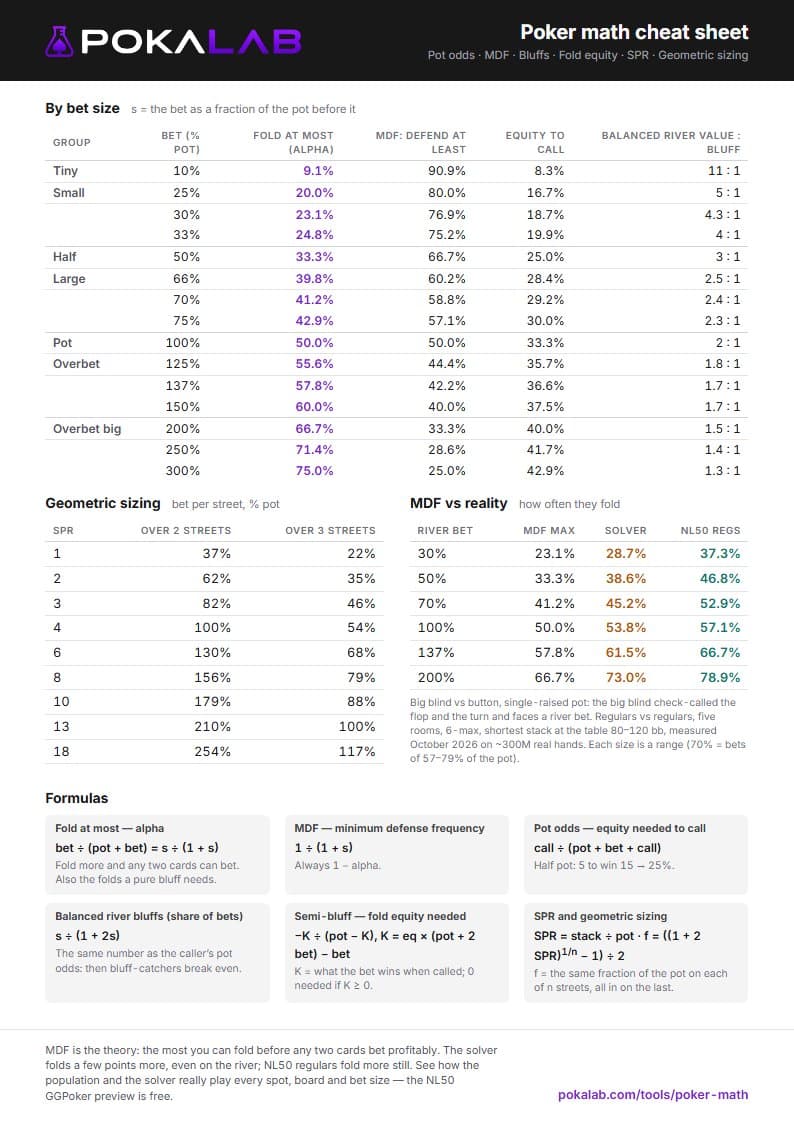
Every number on this page on one A4 page: how much you may fold, MDF, pot odds and balanced bluffs for each bet size, geometric sizing by SPR, how often NL50 regulars fold to each river bet size, and the six formulas. Print it, or keep it open next to your tables.
Download the cheat sheet (PDF)Questions
What is MDF in poker?
Minimum defense frequency is the share of your range you must continue with (call or raise) against a bet so that a bet with nothing cannot profit. Against a bet of s times the pot it is 1 ÷ (1 + s): 66.7% against half pot, 50% against a pot-sized bet. Seen from the fold side, you may fold at most a third of your range to a half-pot bet, and half of it to a pot-sized bet.
How do you calculate pot odds?
Divide the amount you must call by the pot after your call. Facing a half-pot bet into 10 bb, you call 5 to win 15: 5 ÷ 20 = 25% equity needed, or 3 to 1.
What is the difference between MDF and pot odds?
They answer two sides of the same bet. Pot odds are about one hand: is this call worth it? MDF is about the whole range: how much of it must continue so the bettor cannot bluff at will. Against half pot, a single call needs 25% equity, and the range may fold at most 33.3%.
Should you always defend MDF?
Not to the letter. MDF is the most you can fold if the bettor could bet any two cards, and real betting ranges are not any two cards: the solver often folds a few points more than MDF allows, even on the river, and sometimes less, in position. Use it as an alarm. Folding far beyond it, as the regulars measured above do, is exactly what a bettor can exploit.
What is alpha in poker?
Alpha is how often a pure bluff must make the opponent fold to break even: bet ÷ (pot + bet), or s ÷ (1 + s) for a bet of s times the pot. It is always 1 − MDF.
What is geometric bet sizing?
The single fraction of the pot that, bet and called on each remaining street, puts the stacks in on the last one: ((1 + 2 × SPR)1/n − 1) ÷ 2 over n streets. With an SPR of 4 over three streets, that is about 54% of the pot each time.