 pokalab.com
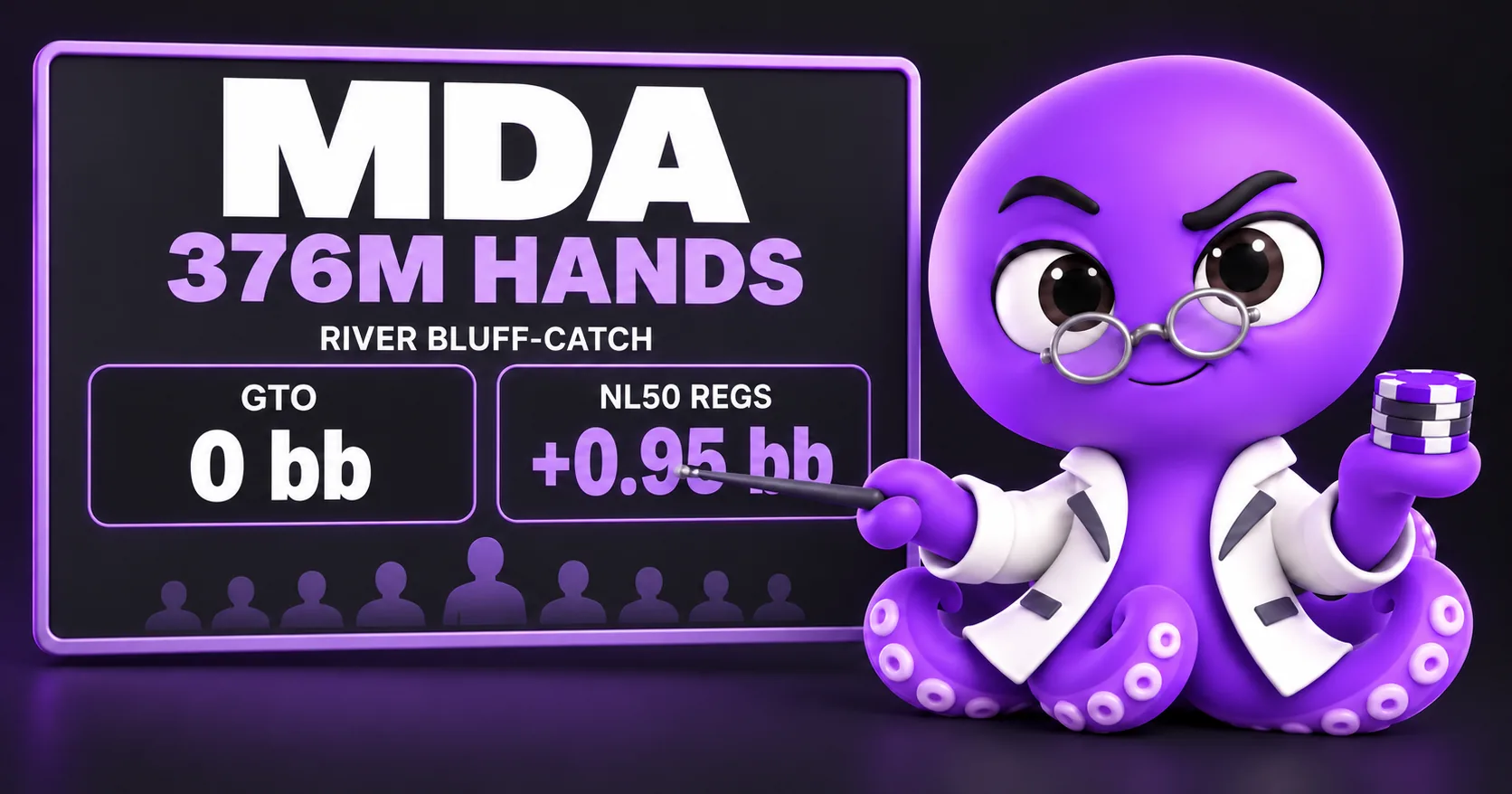
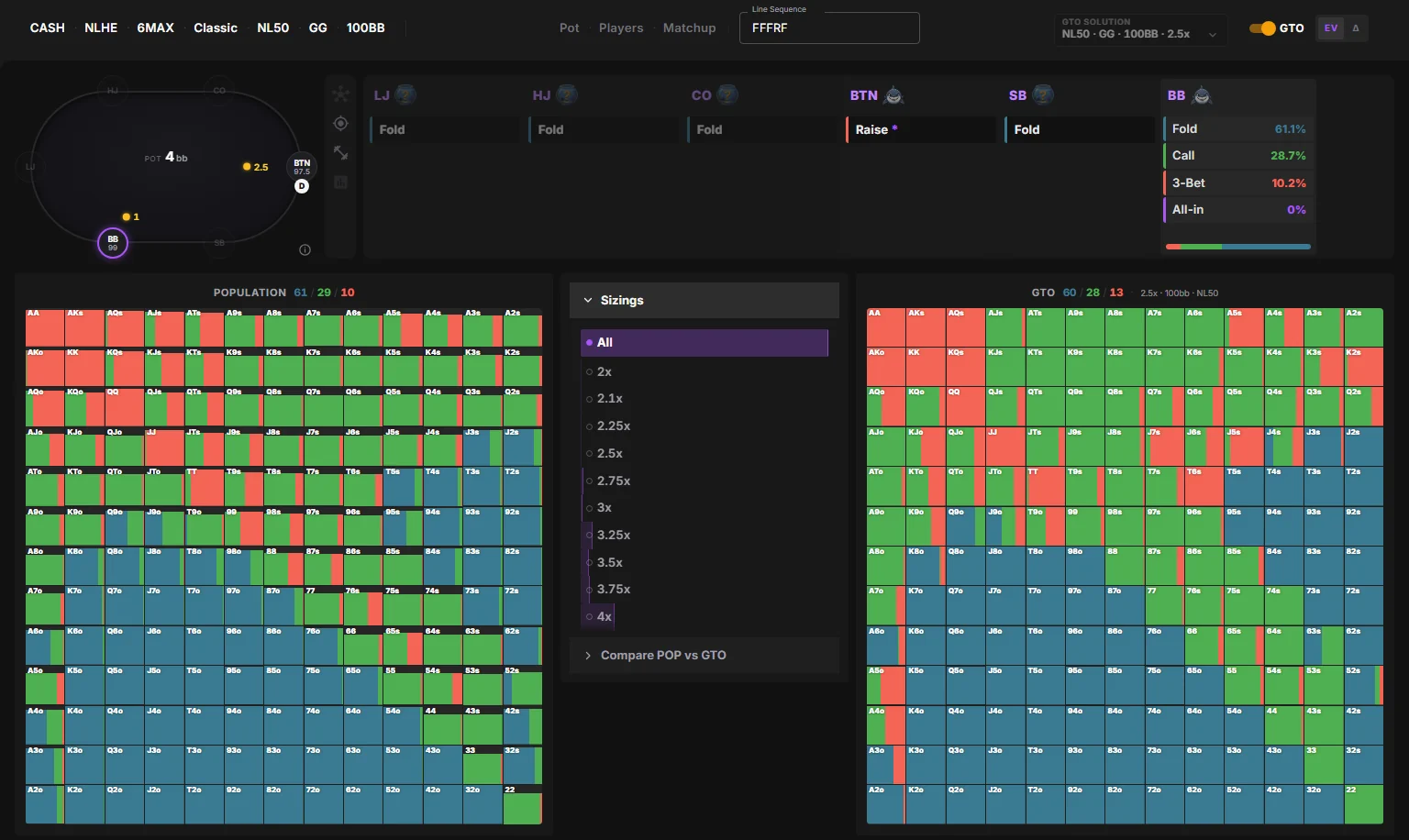
- MDA = how real players play. Every spot measured on 364M real hands, next to GTO.
- GTO makes your bluff-catcher worth 0. NL50 regs bluff more: the same call earns +0.95 bb.
- Same spot, other seat: regs fold 59% (GTO 46%). A bluff earns +2.70 bb.
- That gap is the money — and only real hands show it.
One real spot, two exploits
GTO says break-even. MDA says how much you win against real players.
- Who: NL50 GGPoker, regulars vs regulars, 100 bb.
- Preflop: the button opens, the big blind calls.
- Flop: check, bet, call. Turn: check, check.
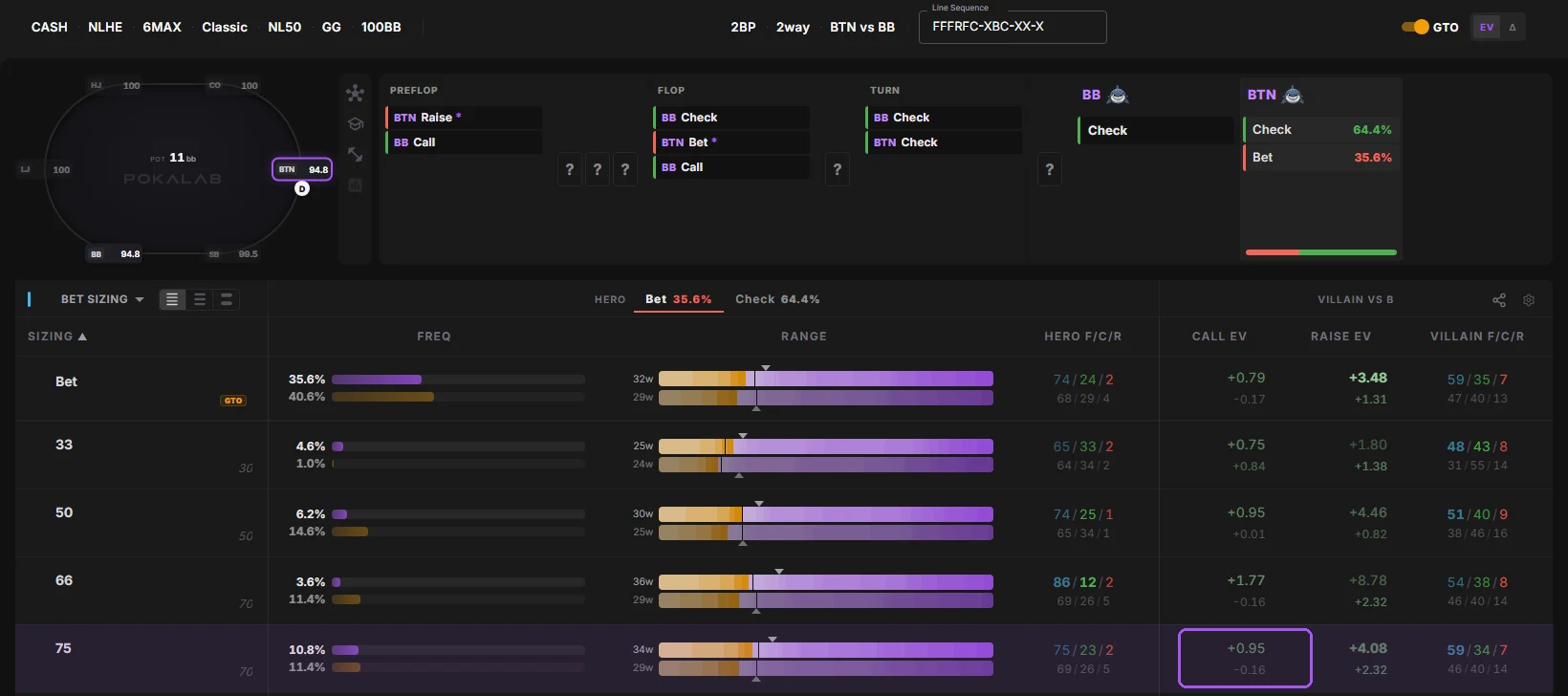
- River: the big blind checks, the button bets 75% of the pot (
FFFRFC-XBC-XX-X).
Against NL50 regs, both plays earn more than GTO says
River, the button bets 75% pot · what each play earns, in big blinds per decision
pokalab.comThe call: worth 0 against GTO
- A bluff-catcher breaks even when about 30% of the bets are bluffs.
- GTO bluffs just that much (29%): your call is worth −0.16 bb — zero, by design.
- NL50 regs bluff 34%: the same call earns +0.95 bb. Call more.
 pokalab.com
The bluff: regs fold too much
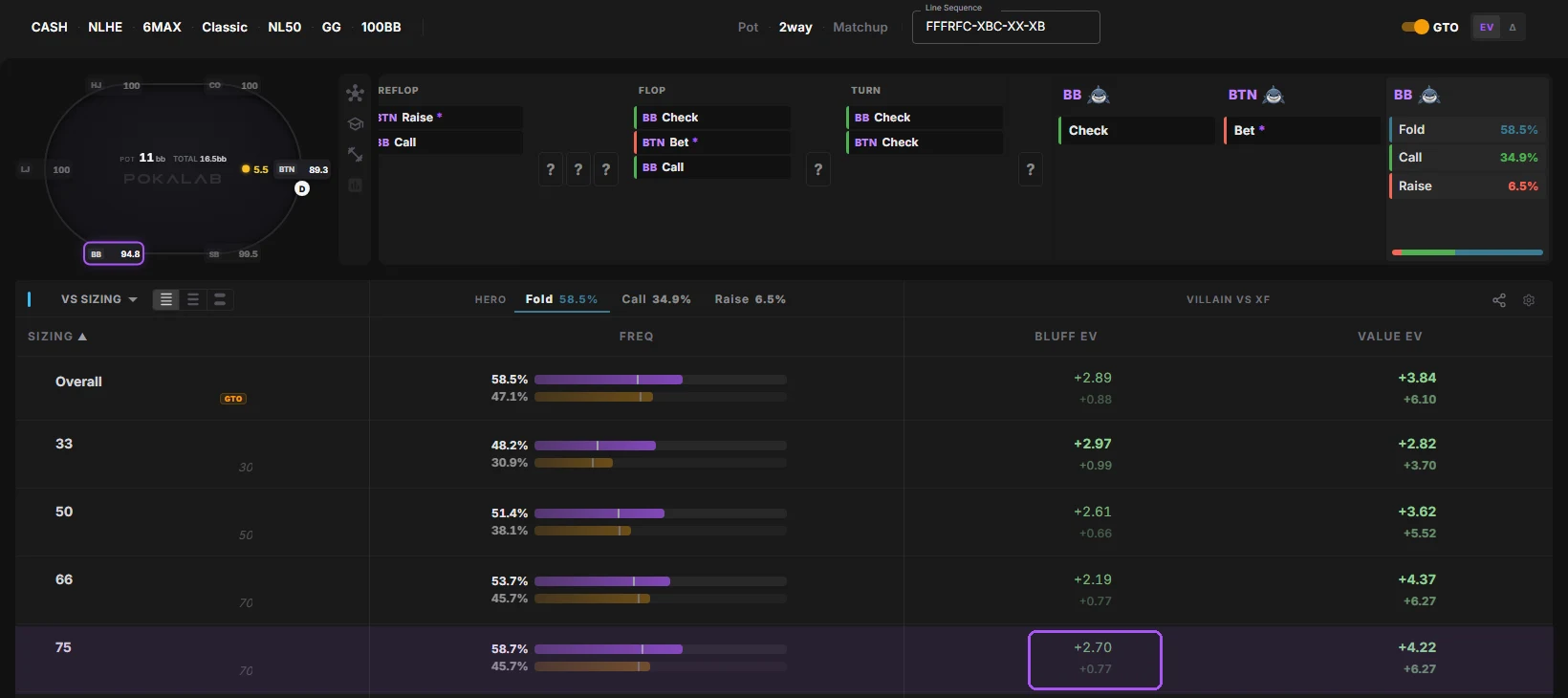
- A 75% pot bluff breaks even when the big blind folds 43%.
- GTO folds 46%: a bluff earns +0.77 bb.
- NL50 regs fold 59%: a bluff earns +2.70 bb. Bluff more.
- Why not 0 against GTO? GTO makes the button’s last bluffs indifferent between betting and checking — and checking still wins a few showdowns. So GTO folds a little more than a bluff with nothing needs.
 pokalab.com
The same regulars bluff too much from the button and fold too much from the big blind. GTO cannot see either: it assumes nobody makes mistakes. MDA measures them, size by size.
What MDA measures
One question: what do real players actually do here?
- Frequencies — fold, call, bet, raise, at every decision of the line.
- Bet sizes — which sizes the pool uses, and how it answers each one.
- Ranges — which hands take each action, next to the GTO range.
- EVs — what a call, a bluff, a value bet or a raise earns against the pool, in big blinds.
- Who and where — room, stake, player type (regulars or recreational players), position, pot type, board texture.
 pokalab.com
MDA, a HUD and a solver
Three tools, three questions.
| Tool | Data | Answers |
|---|---|---|
| HUD / tracker | The hands you played | How does this one opponent play? |
| Solver | None: game theory | What is unexploitable? |
| MDA | Hundreds of millions of hands of a whole pool | How do real players play, and what does it pay? |
How to use it
Pick your pool, follow your line, read the EV.
- Pick your pool — your room, your stake, the player type you face most.
- Follow your line — click the actions of the hand, street by street, down to your decision.
- Read the gap — the pool’s fold, call and raise next to GTO’s, size by size.
- Read the EV — above 0, the play wins against these players: call, bluff or raise more.
Start with your own leaks: the Leak Finder shows where you lose, and MDA shows how the pool plays those same spots.
The limits
Small samples lie, and showdowns hide the losers.
- Sample size — the deeper the line, the fewer hands. Read a broader spot.
- Showdown bias — outside GGPoker, a player who loses at showdown can hide his cards. Ranges built from shown hands lean strong; Pokalab corrects for it.
- Pools differ — NL50 on one room is not NL500 on another. Read the pool you actually play.
Where to do MDA
With your own database, or with one that comes built in.
- Your own database — tracker reports on the hands you collected. Limited by how many hands you can gather.
- A built-in database — Pokalab measures every spot on 364M real hands, cash games (NL2 to NL5k+) and tournaments, next to GTO — free on the micro stakes.
The tools, side by side: the best poker MDA tools, compared.
Questions
What does MDA mean in poker?
Mass data analysis: measuring how real players actually play a spot — how often they fold, call, bet and raise, with which sizes and which hands — on a very large sample of real hands, instead of assuming they play GTO.
Is MDA better than GTO?
They answer different questions. GTO is the strategy nobody can exploit; against it, a bluff-catcher's call is worth about 0. MDA is how real players deviate from it — and where they do, the same call or the same bluff earns real big blinds.
What does EV mean in MDA?
What a play earns on average against the pool, in big blinds per decision, compared with folding (for a call) or checking (for a bluff). Above 0, the play wins money against these players.
What is the difference between MDA and a HUD?
A HUD reads one opponent from the hands you played against him. MDA reads a whole pool — a room, a stake, a player type — from a database far bigger than one player can collect, deep enough to reach the turn and the river.
Do I need my own hand database to do MDA?
Not with a tool that comes with its own population. Pokalab measures every spot on its own database of real hands; your imported hands go to the Leak Finder and stay private.